“Instagram can make a cook despair,” Nigella Lawson once penned in her customary mellifluous prose for The Guardian, a sentiment she expanded into an entire chapter, “A Loving Defence of Brown Food,” in her book Cook, Eat, Repeat. She was, of course, alluding to the omnipresent influence of social media over our collective taste buds, where food is valued not for its flavour but for its photogenic potential. The premise is as unforgiving as it is absurd: cuisine must now be an aesthetic masterpiece to justify its place on our plates, relegating the humble, hearty dishes to the shadows. Once, it sufficed for food to taste good. Now, it must also smile for the camera, possess the allure of a supermodel under perfect lighting, and flaunt a garnish like a hat at Ascot.
This has spawned a vicious cycle, dictating not only what we choose to cook but also where we deign to dine—where the wattage of the Instagram filter has become the most crucial ingredient (and full disclosure, I’m as guilty as the next when it comes to snapping food photos). In Bangkok—a city that might just boast the dubious honour of being the globe’s most photographed food metropolis—one dish has resolutely bucked this trend, standing, or rather stewing, firmly against the superficial tide. Enter Massaman, the dowager queen of Thai brown food, a dish that not only basks in its earthy hue but exalts it; a glorious celebration of brownness, an homage to the shade that food stylists and dieticians dread but that gourmands revere.
The term Massaman (มัสมั่น) is itself a bit of etymological intrigue, a linguistic landmine for historians. Some purists whisper of Persian origins, a subtle nod to “Mussulman,” an archaic term for Muslim, reflecting the dish’s deep roots in Islamic culture. Others, with a scholarly wink, suggest the Malay word “masam,” meaning sour, could have dipped its spoon into this lexical pot. The truth, as with all good myths, is deliciously murky, leaving us to savour the ambiguity along with the curry—and what a curry it is, all the more palatable in a country where the word “curry” isn’t weighed down by any colonial baggage.
Historically, Massaman curry is a culinary confluence, a gastronomic grandchild of spice traders and royal kitchens. It’s the offspring of 17th-century Persian influence and Thai ingenuity, an outcome of cultural intercourse on the high seas of trade and adventure. A dish that journeyed from the Persian Gulf to the ports of Ayutthaya, gathering an eclectic mix of ingredients and an equally diverse fan base along the way. By the time it reached the royal courts of Thailand, it had been pampered, primped, and perfected into the aromatic wonder we indulge in today.
To describe Massaman’s flavour profile as merely “complex” is akin to calling Bangkok “a bit warm”—an understatement of the highest order. At its best, this curry is about balance, a piquant mingling of sweet and savoury notes, punctuated by judicious use of spices that suggest a skilled hand and a heart well acquainted with subtleties.
Monochromatic she may be in all her brownness, but Massaman is far from being a single note when it comes to flavour. The first spoonful hits you with a medley of warm spices—cinnamon, cloves, and cardamom—followed by the luxuriant sweetness of coconut milk that flirts with the tart tamarind, creating a harmony that’s both comforting and electrifying. The curry is grounded by the earthy richness of peanuts and potatoes, giving it a texture that’s as indulgent as a silk sheet and just as sinful. And then, just when you think you’ve pinned it down, there’s a gentle hum of chili heat that lingers like a mischievous afterthought.
Eating Massaman is an act of sheer indulgence. It’s the culinary equivalent of slipping into a cashmere blanket after a bracing day in Bangkok’s unforgiving heat, with the AC on full blast. It envelops you, soothes you, and leaves you with a sense of profound, almost guilty, satisfaction. The process is tactile and immersive—best undertaken with a steamy mound of jasmine rice to sop up the luscious sauce so none of it goes to waste.
Eating Massaman is an act of sheer indulgence. It’s the culinary equivalent of slipping into a cashmere blanket after a bracing day in Bangkok’s unforgiving heat, with the AC on full blast
For a dish this deeply rooted in the past, nothing is quite as contemporarily compelling as the Braised Goat Leg Massaman with Raisin Roti (แกงมัสมั่นขาแพะโรตีลูกเกด) at Charmkrung, a new eatery perched above Bangkok’s Talad Noi—a neighbourhood becoming so hip it practically demands its own hashtag. The entrance is so unassuming you’d likely breeze past it without a second glance. But step into the elevator and ascend to the sixth floor of what appears to be a nearly derelict building, and you’ll find yourself whisked away to a gloriously retro dining den. Here, designer Saran Yen Panya has conjured a space where vintage meets pop art in a confection of kaleidoscopic tiles and 1970s living room nostalgia. Charmkrung exudes an eccentric, stylised charm that’s delightfully kitsch and unpretentious. The only thing missing is a cheeky sign proclaiming, “Sit back, unbuckle your belts.”
“For a dish this deeply rooted in the past, nothing is quite as contemporarily compelling as the Braised Goat Leg Massaman with Raisin Roti (แกงมัสมั่นขาแพะโรตีลูกเกด) at Charmkrung, a new eatery perched above Bangkok’s Talad Noi—a neighbourhood becoming so hip it practically demands its own hashtag.”
At the helm of this nostalgic-meets-now eatery is Chef Jai Aruss Lerlerstkul, a bespectacled talent who honed his chops under the legendary David Thompson at Nahm in London. Thompson, that culinary crusader from down under, brought Thai cuisine to the Michelin-starred masses. Thankfully, Jai eventually swapped Blighty for Bangkok (along with several of his fellow alumni from Thompson’s kitchen), and the dining scene here has been reaping the benefits ever since. Charmkrung is the latest outpost in Jai’s ever-expanding portfolio of punchy dining venues, where traditional recipes are given the respect and reinvention they deserve.
Yet, for all its colour-infused, throwback-diner allure, it’s the unapologetically brown Braised Goat Leg Massaman that steals the show. Bone-in and jutting out like a defiant middle finger to every micro-managed micro-herb, this dish is a visual and olfactory tour de force that sits back in mocking defiance of modern minimalist plating. It’s both humble and arresting—so arresting it could halt a tuk-tuk in its tracks. It’s a striking visual, appealing more to our eyes than a camera lens ever could. Why? Because our eyes are attached to our other senses, like smell. Your eyes tell you this is going to be good. The camera lens doesn’t necessarily agree. But there it is, the unphotogenic pleasure of brown food.
Put your phone away; this is a dish to be savoured, not snapped. The goat leg luxuriates in a pool of Massaman curry that radiates a sumptuous caramel glow. It’s the kind of brown that Nigella Lawson would celebrate as the pinnacle of “brown food”—authentic, unpretentious, and soul-stirringly good.
The goat leg itself is all tender succulence, braised to the point where the meat yields effortlessly to the slightest nudge of a fork, cascading into the luscious curry like an avalanche of edible delight. The Massaman sauce is a heady concoction of coconut milk, cinnamon, cardamom, and star anise, simmered to a velvety richness that envelops the palate in layers of sweet, savoury, and gently spiced comfort. And then there’s the raisin roti—a golden, flaky morsel infused with hints of raisins that offer a cheeky burst of sweetness amidst the spiced opulence of the curry. The roti’s crisp edges and tender insides make it the perfect companion, mopping up every decadent drop of the Massaman with sycophantic eagerness.
This is brown food in its most brilliant incarnation—comforting, complex, and irresistibly moreish. It’s a triumph of tradition over trend and a celebration of food made with love rather than for likes.
Nigella would most certainly approve.
Author’s note: It’s best to call ahead, as the Braised Goat Leg Massaman (มัสมั่นขาแพะตุ๋น) isn’t always on the menu, but fear not—the Braised Beef Cheeks offer an equally glorious experience, minus the leg bone.
Bangkok’s collective memory can seem shortsighted — increasingly blurred the further removed it is from its past. For many of us who live here today, it can be hard to imagine a time when the cityscape was not dominated by concrete, condominiums and highways, but rather, dotted throughout with wooden houses, low rise buildings and canals. It may be harder still, to believe that all the modernity, prosperity and urban sprawl that defines the city today, came into being largely during the last five decades. Perhaps that is why one woman’s family house-turned-museum in Bangkok’s Bang Rak district remains a quietly charming, yet powerfully compelling guardian of this city’s place heritage prior to and post-WWII.
When I moved to Bangkok over two decades ago, it quickly became apparent to me is that the story of this city, time and time again, is told through the lives of its prominent men and women — royals, aristocrats, tycoons and politicians. Larger than life individuals whose accomplishments and societal impacts are formed often by equal parts fact and folklore. Many of the city’s museums and institutions now reside in buildings that were once the elegant homes of these individuals and their illustrious families — some palatial in size and status. But what of the lives of the average, everyday man and woman? Over a decade ago I read an article that eventually lead me down a quiet street off of Charoenkrung Road where I found the story of one middle class family, lovingly told through a collection of ordinary items, weaving an evocative tale of daily life in Bangkok during the first half of the last century — housed in what is now appropriately named the Bangkokian Museum.
Situated on Charoenkrung Soi 43, the Bangkokian Museum consists of a cluster of three delightful wooden houses dating from the early 1900s, surrounded by a lush garden, including several ponds, as well as a row of midcentury shophouses forming what was once the family compound of Associate Professor Waraporn Surawadee, who inherited the estate from her mother, Sa-Arng Surawadee (formerly Tanboontek). Prof. Waraporn’s family, through her mother’s family line, have lived on this street for three generations from the days when it was known as Trok Saphan Yao (Long Bridge Lane), alluding to the structure that used to define the area, which was once crisscrossed by canals, long since paved over by roads. This family epitomised what in the early 1900s was the burgeoning educated, land owning, upwardly mobile Thai-Chinese merchant class that would in later years come to define Bangkok’s social landscape.
Interior of the upstairs of the main house.A bust of Dr. Francis Christina, Prof. Waraporn’s mother’s first husband.
The Surawadee household was a large one characteristically defined by its strong women. In addition to Prof. Waraporn, her grandmother, her mother and her sister all worked in education.
“What you see here, this house, now a museum, is truly a product of circumstances” says Prof. Waraporn. “My mother married twice, first to Dr. Francis Christian, a British-Indian physician who had settled in Bangkok. Unfortunately he died at a young age not long after they were married and they had no children at the time. My mother inherited his modest estate. She then married my father Bumphun Surawadee and together they built this house in 1937 on a plot of land her family already owned.”
Born shortly after of the house was built, Prof. Waraporn lived on the property her entire life, along with with parents, her grandmother, her aunt and several siblings — a house not unlike that of Louisa May Alcott’s Little Women.
By the time Prof. Waraporn inherited the estate from her mother, she was the only surviving direct descendant. She was unmarried, with no children of her own. Rather than being content with enriching herself further from what her mother had left her, she self-engineered an idea to convert her family home into a museum to be shared with everyone — as a gift to all Bangkokians. Eventually Prof. Waraporn formally entrusted her family estate to the Bangkok Metropolitan Authority (BMA) on October 1st 2004, to be managed as a public museum with free admission, on the condition she could continue to live on the property (in a modest former guest house) for the remainder of her life.
Prof. Waraporn once said in a TV interview, “I didn’t want to sell the property. What would I do with all that money? All I’d have is just money. I wanted to do something in honour of my mother. I wanted to have the house survive intact for perpetuity. I didn’t need all the material items my mother had used and saved over the years. I’ve worked my entire life and I can live comfortably on my own means. I came to the understanding that what I had inherited as a whole, could be used for the greater public good.”
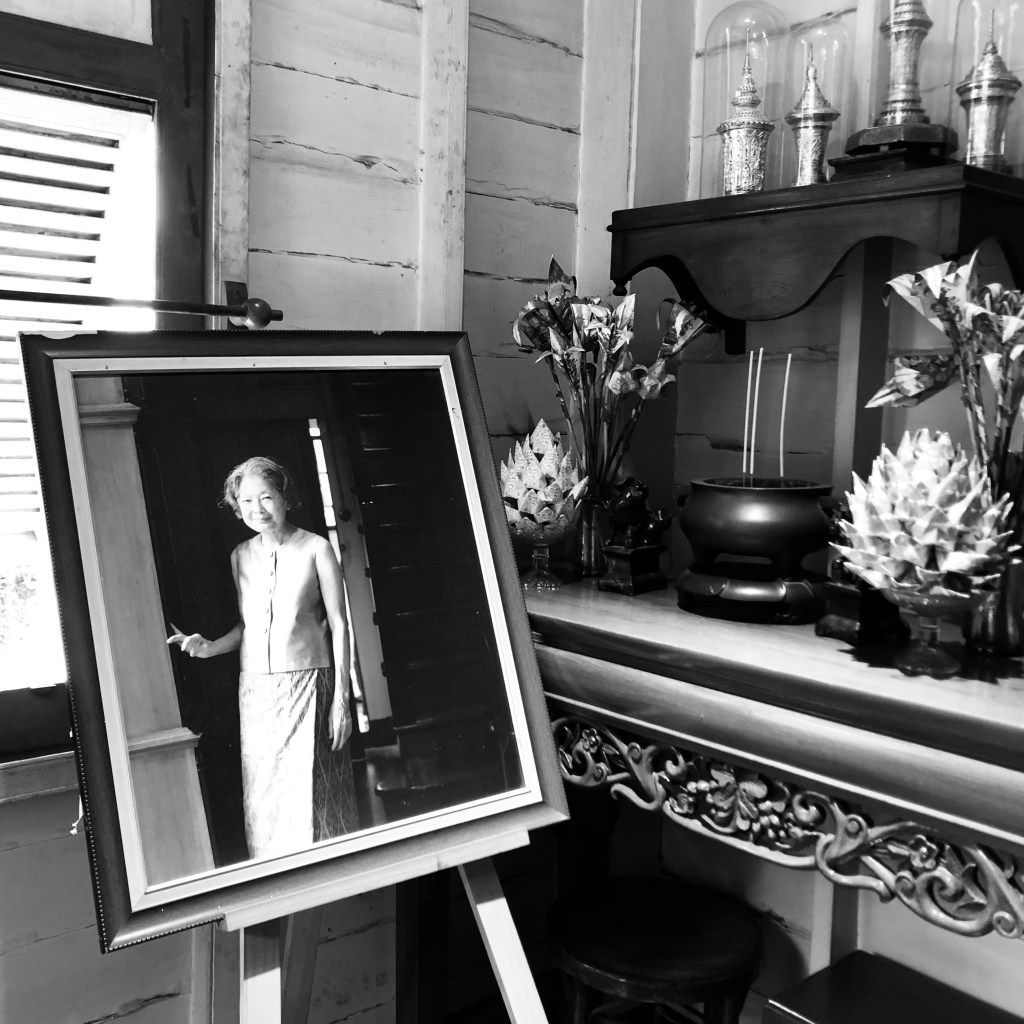
Over the years, I revisited the museum on numerous occasions and had the pleasure of being shown around the property by Prof. Waraporn herself, a woman small in stature, but with a commanding presence and an admirable command of English. The onetime owner turned tenant was a constant presence on every visit I made, and she was quick to correct anyone who still referred to the house as ‘hers’.
“It’s not mine anymore,” proclaims Prof. Waraporn, “it belongs to all of you. I’m just a volunteer, keeping busy taking care of the place and sharing my stories when I’m not working. I want to help keep telling the story of all these things because this was a real working house, filled with real working people — my family, it wasn’t just for show. We lived comfortably, we were happy here with these things.”
“You see, I come from a time and a generation where material possessions were harder to come by. Whatever we had, we had to take care of them. If it broke, we had to try our best to fix it — it was just what we did in those days. The idea of easily replacing things with something new just didn’t occur to us at the time. Things were made to last!”
“Some people think I’m a collector, but I’m not. These are all ordinary items found in many households. We simply threw away less things back then. Everything was valuable. We used things longer back then. Being someone who has taught my entire life, I wanted all these things my family acquired over the years to have a new life, to be used to educate people for generations to come on how we all used to live. Maybe there will be something they can learn from it, if they take the time to come and visit. I know they can learn from it.”
And what things indeed.
Within the three main structures that comprise the museum (two principle houses and a row of shophouses) are a treasure trove of everyday items largely dating from the 1930s through to the 50s. This was a period of tremendous changes in Thailand — the end of Thailand’s absolute monarchy, industrialisation and war, followed closely by the post-war economic boom.
Much of the Western style furniture dates from the time of Dr. Francis, lovingly kept and used by Prof. Waraporn’s mother through the years. She inherited all his belongings, including his medical equipment, many dozens of books related to medical studies, diaries, letters and other memorabilia.
“My mother kept all his [Dr. Francis] things in several large trunks. For decades all these things sat untouched, and protected. Even daily items like shaving kits, branded tins of Dr. Francis’ favourite food items, all survived intact, in the condition you see today,” noted Prof. Waraporn.
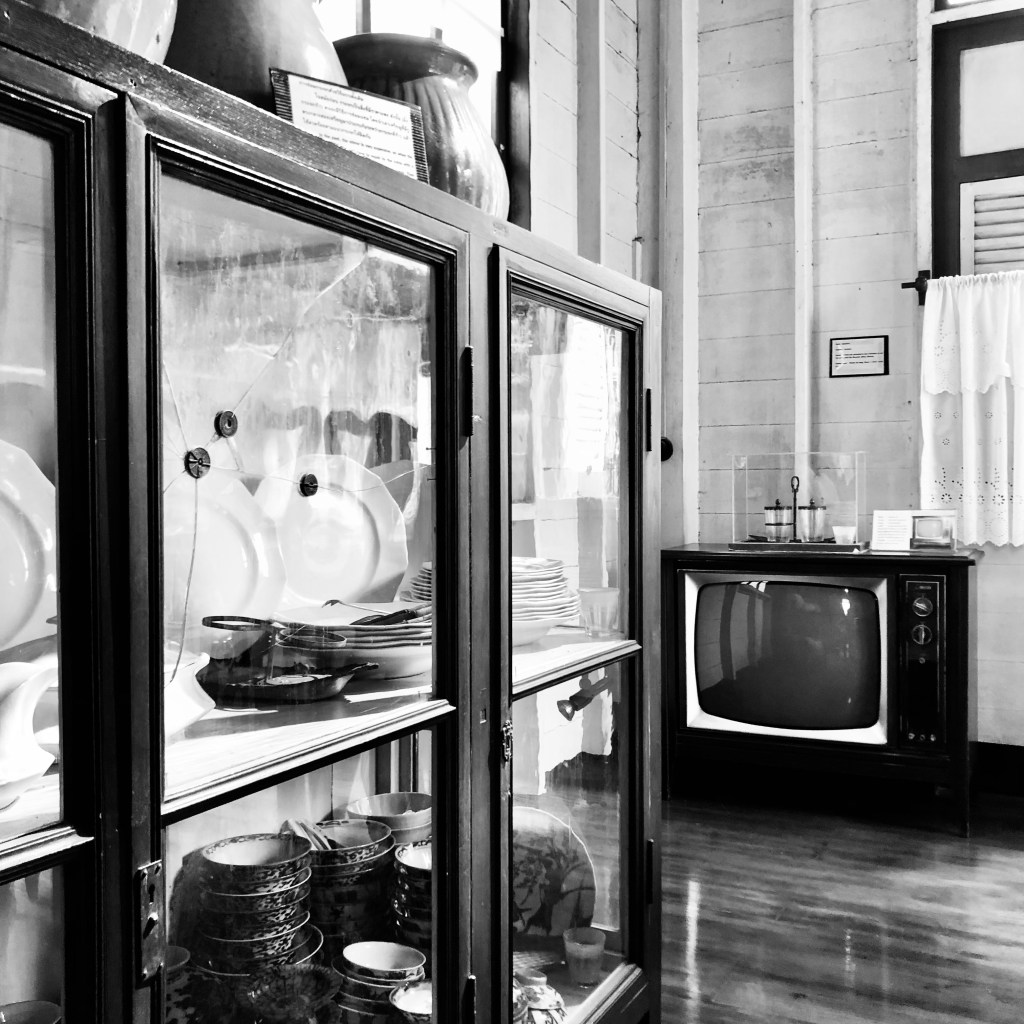
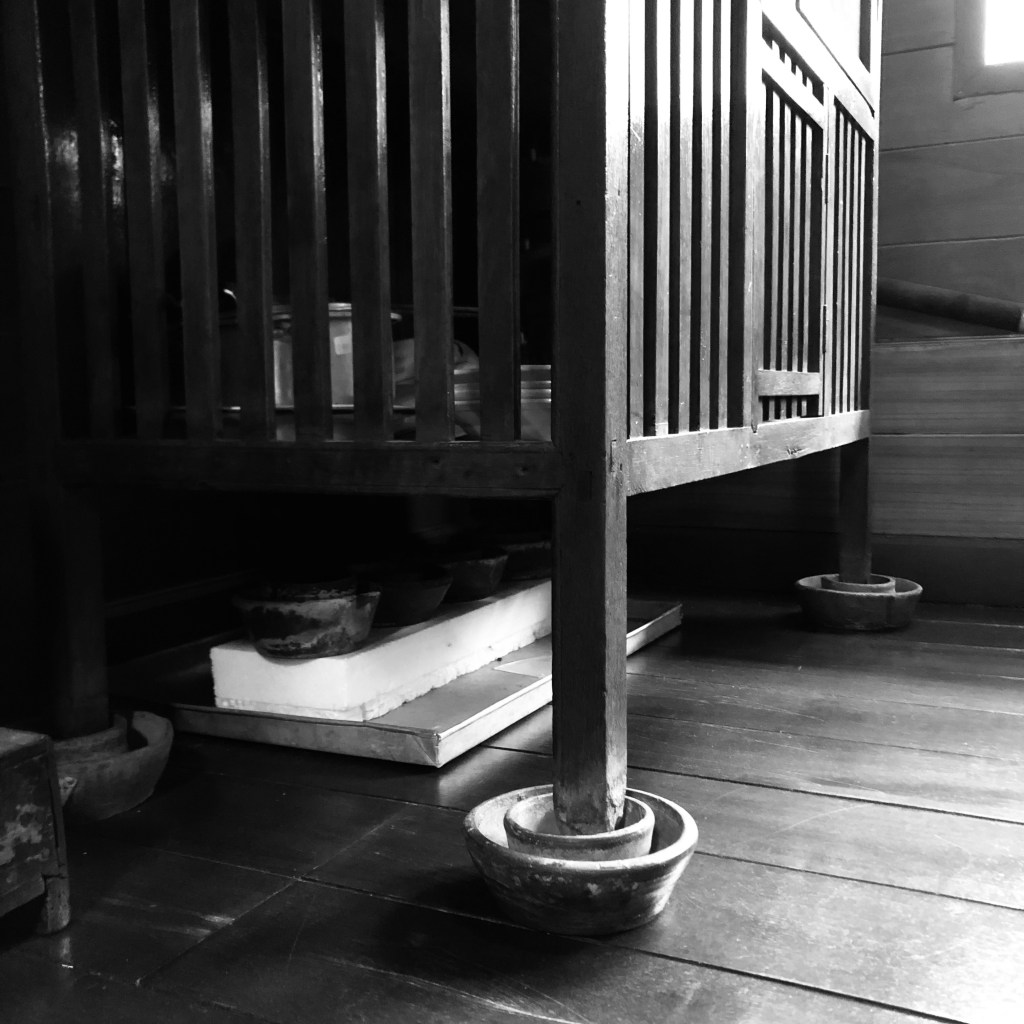
Throughout the main two-storey, seven room house, you see a convergence of tastes, technologies, and lifestyles. Where in one room you may see a betel nut chewing set with it’s accompanying spittoon, once belonging to Prof. Waraporn’s grandmother, alongside it is a distinctly Western style dressing table with perfume bottles and cosmetics. Thai style Bencharong bowls are showcased with European crystal, Persian ceramics and Chinese porcelain. Although upstairs the main house had a Western style bathroom with indoor plumbing, adjacent to the shower are several large cistern jars used for Thai style manual bathing. Downstairs there is smaller bathroom with no plumbing, modestly outfitted with removable enamelled tin ‘bowls’ set underneath wooden stools serving as toilet seats dating from the time when waste would be picked up regularly from house-to-house. by a cleaning company utilising horse drawn carriages.
The second two-storey house, is in fact the oldest, dating from 1929. It was intended as a small clinic for Dr. Francis with modest accommodation upstairs and was originally located on another plot of land in the Tung Maha Mek area (Sathorn) of Bangkok. Following the doctor’s untimely death, Prof. Waraporn’s mother decided to move the structure (which like the main house was built of teak without nails and designed like many structures of that era, to be easily dismantled when necessary) to its present location. Many of Dr. Francis’ personal items and professional equipment are now displayed in this building.
Coins, tied with wire used t repair broken glass panels on a cupboard – a long lost art of repairing.Equipment used for Dr. Francis’ ClinicSome of the family’s original, and much used kitchen tools and cookware.
The row of modest shophouses once rented out by the Surawadee family to various business tenants, have now been converted into one uniform space housing one of the most comprehensive collections of middle class items to be found anywhere in Bangkok. No item was considered too small or too insignificant to be included. Cooking utensils, sewing kits, writing instruments, report cards, commemorative memorabilia, calendars, tools, gardening items, clothing, toys, all used by generations of Prof. Waraporn’s family and thankfully not thrown away. Everyone I have ever taken to the Bangkokian museum can’t help but smile and see things they, or their parents, or their grandparents once owned.
“We were lucky, we had space to keep all these things. I admit, we kept a lot of things, but they were all used and well loved for years and years. Some people might think we were rich, but really we were not. We all worked hard and we valued all these things we worked for. Nothing here is really all that special, what is special is that they all survived and that they all were used by my family in this very location. That’s what I want people to understand. Even normal people, normal lives, normal items, can have value if you give them that value. That’s the lesson I’m trying to teach,” says Prof. Waraporn.
The upper floor of the shophouses has been set aside to display a history of the Bang Rak area in which the house is located in. Aside from Bangkok’s the old town area of Rattanakosin, the Bang Rak area has born witness to so many of Bangkok and thereby Thailand’s historic ‘firsts’. The first modern road, the first foreign missions, the first bank, the post office, the first modern flats, the first hotel, the first department stores, the first tram line. The list goes on and on, and all of it within walking distance of this elegant, but unassuming family home.
“I was happy here. It used to be my home. Now it’s everybody’s home,” says Prof. Waraporn.
You might think that bequeathing her family home to the city was enough. That the joy she clearly received from being the custodian of this heritage was sufficient for Prof. Waraporn. Well, you would be wrong.
In early 2016, the long empty plot of land adjacent to the Bangkokian Museum came up for sale. Prof. Waraporn immediately expressed an interest in the small piece of land but was quickly rebuffed by the owner who said he had already found an interested buyer without any public bidding who agreed to purchase the land for just over THB 30 million. The buyer came from a family who is from the community who wanted to build a low rise mix-use residential commercial building. When construction was set to begin, Prof. Waraporn was astonished to find out that in fact a eight-storey commercial building was now to be built.
“I couldn’t believe it. I couldn’t allow this. I felt I had to do something,” Prof. Waraporn thought at the time.
Undaunted, what followed in the subsequent weeks was a truly remarkable crowdfunding campaign to secure a better future for the Bangkokian Museum, led by this semi-retired octogenarian who had already given much of her inheritance to the city she loved. Prof. Waraporn had long eyed the adjacent plot of land because she felt that the Bangkokian Museum’s biggest weakness was lack of parking. Museum attendance was largely pedestrian. If she could secure this plot, her vision would be to provided parking space as well as expanded community areas for education and public enjoyment.
Naturally, she reached out to the BMA, first to ascertain whether the construction of the eight storey building in this area was legal. In fact it was, due to a change in the zoning laws quietly approved in 2016, unknown to Prof. Waraporn and to the larger public as well. Second, if the construction of the site was legal, then the BMA should counter offer to buy the plot and enhance the Bangkokian Museum which by 2016 had already become overwhelmingly one of the most visited and popular of the 27 district museum managed by the BMA.
“They replied with silence,” lamented Prof. Waraporn. “I already gave the city my family estate worth in today’s money well over THB 100 million, this plot of land is small in comparison but its acquisition would be of huge benefit to the museum and the community. I knew I had to take matters into my own hands.”
Together with a team of volunteers, she offered to make a counter offer to the owners, who in the course of a few weeks now said the land with worth THB 50 million. Prof. Waraporn did not have that much money, what assets she did have was tied to the Insat-Sa-Ang and Dr Francis Christian Foundations which Prof. Waraporn herself had set up with money she had inherited, to honour her mother and her mother’s first husband. Through the foundation, Prof. Waraporn put THB 30 million towards the offer and negotiated down with the owner for a purchase price of THB 40 million. She was still THB 10 million short.
Not to be deterred, she had faith that she would be able to come up with the rest of the money required.
“I never had any doubt we could do it, it was only a question of how soon we could raise the money. I used the THB 30 million as a deposit, that would be forfeited if the rest of the amount could not be raised within 3 months,” said Prof. Waraporn.
Within days, she and her volunteers reached out to the press, the museum’s list of visitors, former students and colleagues, who in turn used the power of social media to spread the word. Thousands upon thousands of donations poured into a hastily set up account in the name of the two foundations. Prof. Waraporn tirelessly gave interview, after interview, took journalists on house tours, pleaded with the public to look into their hearts and give what they could if they believed buying this land for the museum was a worthy cause. She encouraged everyone who hadn’t yet been, to come to see for themselves what the museum was about. To see where she was born, where she grew up, and where she had devoted her life to, now for the benefit of everyone.
“People asked me why I didn’t appeal to any businesses or wealthy people for the money. I said this museum was given to the community. Its important the community has to be behind this initiative to acquire this piece of land, to have sense of grassroots ownership,’ Prof. Waraporn told press who had gathered at the museum in the initial days of the crowdfunding campaign.
In 10 days, thousands of small individual donations raised over THB 10 million. By August 2016 the acquisition of the adjacent piece of land was secured.
Prof. Waraporn was a woman of strong conviction who wouldn’t take no for an answer. Stubborn and resilient, an unexpected visionary who sought out to show that even at her age, she still had more to give.
“I know my story is unique. I don’t expect other older people to suddenly think their homes should be turned into museums too,” Prof. Waraporn says amusingly. “But I want people to see that old people, old things, old lives still have value, especially to the younger generation, who I hope can learn from us.
Prof. Waraporn passed away in January 2017, a less than half a year after successfully leading her land acquisition campaign. She died on the grounds of the Bangkokian Museum, her former home where she was born. Till her last days, she continue to fight for her legacy, now the heritage of every Bangkokian.
I recently revisited the museum in February 2023. All the familiar faces of the museum’s volunteers I had come to know over the years were still there. The museum was lovingly untouched by time, everything was just as it was. What had changed, was the adjacent plot of land. On it was the physical embodiment of Prof. Waraporn’s final wish, a multi-function communal space managed by the Insat-Sa-Ang and Dr Francis Christian Foundations — a brand new, recently completely structure called Ruen Waraporn (Waraporn’s House).
Professor Waraporn Surawadee, who was born, lived her entire life and died on the grounds of the Bangkokian Museum.
Bangkokian Museum is open 10am-4pm from Wednesday-Sunday. Admission is free. For more information call 02-233-7027 or 02-234-6741.
To get there, travel by car or bus No.1, 16, 35, 75 and 93. Surasak and Saphan Taksin BTS stations are both walking distance Fromm the museum. Parking is available.
7 responses to “As It Was: The Bangkok House Where One Tenacious Woman’s Gift of Nostalgia Lives On”
Thank you so much for the comment. I’m glad you enjoyed the read! There are so many hidden gems in Bangkok. The Bangkokian Museum and the story of it’s founder is one of my favourites. Thanks for taking the time to read my story.
On any given day, hundreds of thousand of commuters (myself included) might glide high above the congested traffic of Taksin Bridge, most will be blithely unaware that they are passing by a unique religious structure, obscured by glittering spires — one that pays tribute to commerce, transportation, and the immigration of one of Thailand’s most important ethnic communities.
There are two commonly understood choices to be made when I descend from the train platform at Saphan Taksin. Do I turn left towards the river in order to board the numerous ferries connecting passengers to shopping centres, luxury hotels and condominiums, or do I turn right and head towards Charoen Krung and the district of Bang Rak? What is noticeably less traversed, is an alternative stairway exit on the Charoen Krung side heading towards a direction away from Bangrak. It was in this direction that I decided to walk down one day, curious as to what the enormous shimmering Grand Palace-like structure visible from the train platform was.
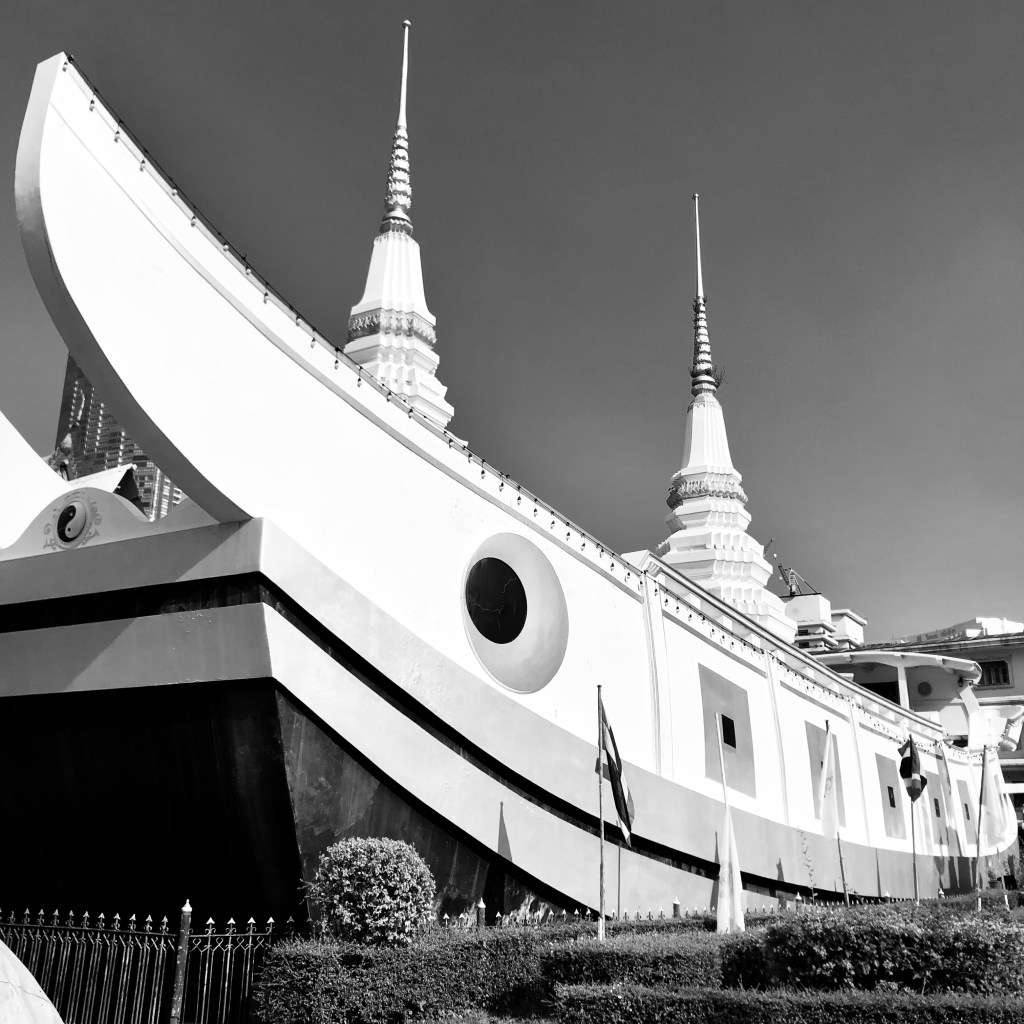
Once I passed through the gates of the temple, I was awestruck by what I saw. A full size 40 meter edifice in the unmistakable shape of a Chinese junk gleaming in brilliant white and accented with gold. The only detail that was not ship-like were the two delicate needle-tipped stupas (pagodas) rising from where the masts normally would have been.
Kenneth Barrett, in his definitive book, “22 Walks in Bangkok”, provides several historical accounts of how this area of the river was once bustling with flotillas of junks, offloading their wares with their unmistakable Venetian blind-like sails. For centuries these ships brought trade, new ideas and new peoples to Thailand, most prominently being the Chinese community who quickly established themselves as the leading merchant class.
Although the temple grounds date back to a period prior to the founding of Bangkok, the landlocked chapel was commissioned during the reign of King Rama III, whose statue is situated in a ceremonial platform in front of it. A formidable monarch who built his reign around international commerce and who himself is often regarded as the kingdom’s Father of Trade.
Temples in Thailand are hallowed environments, often with commonly repeated and highly symbolic design elements. Where Yan Nawa Temple’s Junk shaped Chapel deviates from the norm, apart from its shape, is that it was constructed to pay tribute to something decidedly not of the spiritual world. Whether you admire or not the theme park aesthetics of it, you are unlikely to find another temple like it to this scale in this country. The symbolism of it resonates powerfully and clearly.
One of my favourite aspects of exploring Yan Nawa Temple is that you can actually ‘board’ the vessel through a narrow entrance underneath the stern. Which also gives you a different perspective of the surrounding area as well as of the chapel itself.
The ship-like chapel structure.The narrow entrance located under the stern.Atmospheric tunnels within the structureOne of the pagoda ‘masts’.View from the prow.A gilded shrine on the prow.
As I stood there on the prow of the ship, I thought not only of how the building served as a memorial to something that had brought enormous wealth and prosperity to Thailand, but also that it was a tribute to a mode of travel that by the time it was consecrated, had already been made out of date by the rise of another form of transportation — steamships. I recalled one of my favourite paintings in London at the National Gallery, J.M.W. Turner’s ‘The Fighting Temeraire’. If you’re familiar with it you may know that it too is a poignant tribute to one outmoded form of transport, in that case, a fighting man-of-war sadly being dragged into retirement by a steamship.
In perhaps a final twist of irony, this chapel of trade — a ship unable to sail away, often visited by Chinese tourists who are told of its importance to the Thai-Chinese community — was built of reinforced concrete, then one of the most modern building materials at the time. For over a hundred and fifty years she (I suppose it must be she, since ships are traditionally feminine) has born witness to a city changed nearly beyond recognition, quietly sitting in the shadow of another mode of transport, ‘sailing’ high above her.
Yan Nawa Temple
40 Charoen Krung Rd, Yan Nawa, Sathon, Bangkok 10120
On March 16th, 1864 a new road was inaugurated in Bangkok, symbolically and literally paving the way for Thailand’s progress towards modernity. At the starting point of this historic road remains a little noticed remnant of one of the oldest modes of transportation.
Do you know where the oldest paved road in Thailand begins? Charoen Krung, meaning prosperous city, starts not in the former European district that housed consulates and foreign owned businesses, but at the southeastern corner of the Grand Palace (known as Mani Prakan Fort), where it intersects with Sanam Chai Road, it is also anchored by the imposing neoclassical Territorial Defence Command HQ (1922), The Temple of the Reclining Buddha and Saranrom Gardens.
Mani Prakan Fort, Grand PalaceSaranrom Gardens
Construction on the road began in 1862 at the time when the city was still dominated by canals. Boats, not BMWs ruled the way. In fact, the very first automobiles where nowhere to be seen on what was then commonly known as ‘New Road’ until over thirty years later in 1897 — most likely astonishing locals who were probably still adjusting to the shift from river sampans to horse drawn carriages and trams. Today’s view looking directly outwards onto Charoen Krung Road has remained hardly unchanged in nearly 160 years.
Near one corner of this intersection where Thailand’s push towards modernity began, is one of my favorites — an almost whimsical, largely unnoticed reminder one of the oldest modes of travel — an elegant platform for boarding or alighting elephants.
An elegant platform for boarding or alighting elephants.
Famous the world over for its street-side eats, Bangkok’s culinary reputation is often reflected in long lines and increasingly numerous Michelin Guide ratings, but a stroll down one alley in one of the city’s oldest neighbourhoods reveals a hidden gem, where eating is a pleasure savoured along with life, at a deliciously slower pace.
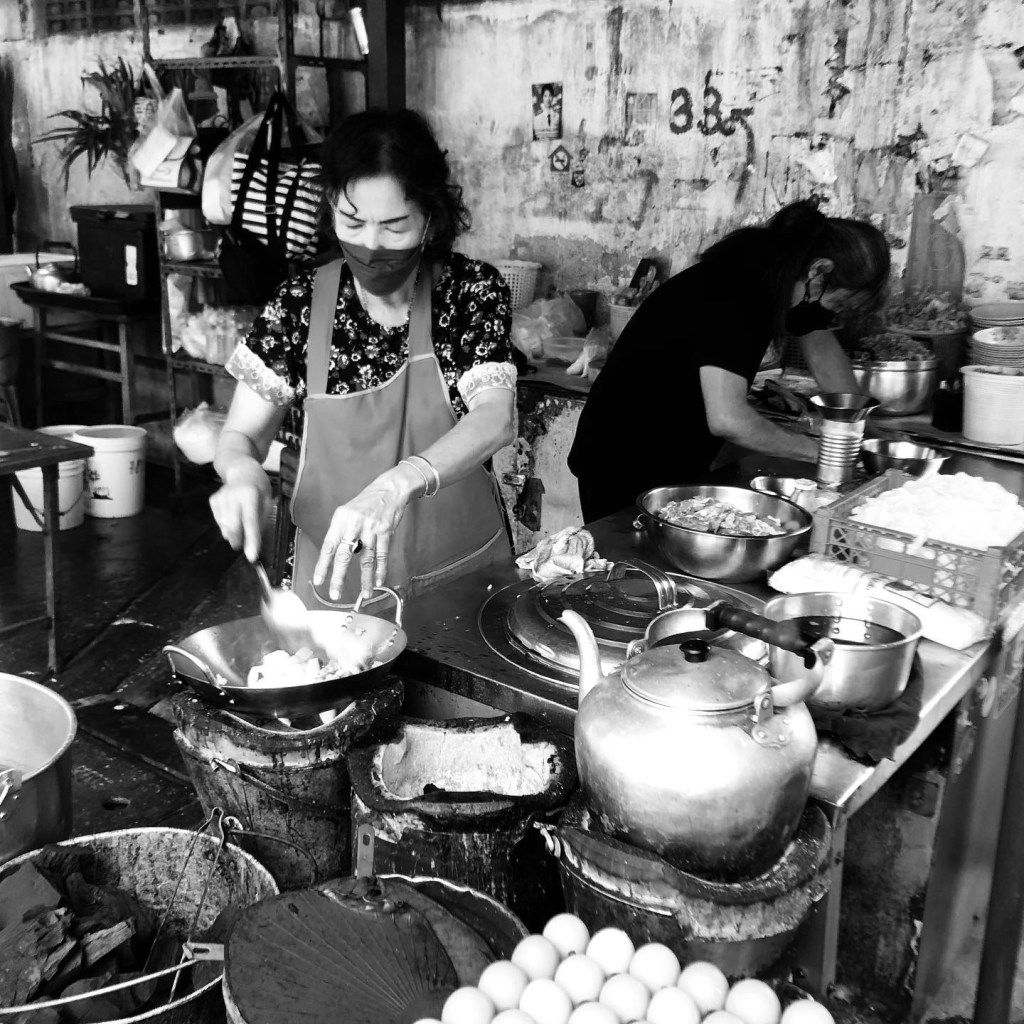
If you walk down to the end of Charoen Krung Soi 1, also known as Trok (alley) Wisut, and make a left at the unexpectedly imposing community shrine to Brahma, you will find an old-school example of what I call slow street food. There’s no rushing Aunty Pien’s copper pan-fried chicken noodles (Kuay Thiew Kua Gai). No Grab drivers and no hashtaggers (except possibly, for me of course). Starting early most mornings, you’ll find her frying fresh batches of pork scratchings (to be generously sprinkled over her famous noodles) over a charcoal stove.
The Brahma Shrine at the end of Soi 1.
She’ll smile and tell you to take a seat at what can only best be described as two makeshift communal long-tables alongside Klong Lod (amusingly translated by us visually centric Thais as Drinking Straw Canal, owing to its long and narrow proportions). The canal forms a back alley of sorts to this old community once populated by Mons transplanted from Burma around the time of Bangkok’s founding.
Aunty Pien makes only one kind of noodle dish and she does it exceedingly well. Kuay Thiew Kua Gai happens to be a ubiquitous Thai take on stir-fried noodles and is almost always made with chicken. Aunty Pien’s addition of her fragrant, salty pork scratchings are her own trademark touch. She also infuses her complimentary drinking water with pandan leaves and lemongrass.
Aunty Pien frying a fresh batch of pork scratching in the morning.
While you wait patiently for your noodles — which are always cooked one portion at a time — you may be surprised to notice fish swimming in the unexpectedly clean, almost elegant canal. All around you are signs of lives lived at a slower pace. An increasingly all too rare observance in mad-dash Bangkok.
Eating here is basic, but rewarding. Calm and delicious. You may even hear Aunty Pien reminisce to her regular customers about the old days, such as how fish sauce nowadays isn’t what it used to be. Indeed it isn’t. That’s what happens when you’re quietly not in a rush. You hear things.
Aunty Pien’s Fried Chicken Noodles
Can be reached from either Charoen Krung Soi 1 or Fueang Nakhon Soi 14, Wat Ratchabophit, Phra Nakhon, Bangkok 10200










 The Footpath Files
Leave a comment